|
|
 Nick Karagiaouroglou
 {K:127263} 1/23/2009
|
Thanks a lot for the very useful info, Ian!
Indeed a tube could also do, but the result would come out of the depiction errors rather than out of a wished and well designed behavior. So, I would better go for the lens or polarizer.
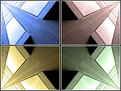
The Gauss curve of this one runs also flat on the highlights but obviously not flat enough. The green components are the strongest on the highlights, followed by the blue, while the red are rather weak there. After a small tweak of the levels of green and blue it seems a bit better to me (attachment). So, perhaps the main portion of the glare was green and blue - for what reason? I assume it goes back to the reflection properties of the material.
But then, using a lens would mean that also the reds would be attenuated accordingly and we don't want that. Using a polarizer might avoid that since it would mean to cut only the strong glares from blue and green. Perhaps a combination of both could be used here.
Thanks a lot for the fruitful input, Ian!
Nick
|

Comparison before/after |
|
|
|
 Ian McIntosh
{K:42997} 1/22/2009
Ian McIntosh
{K:42997} 1/22/2009
|
perhaps a polariser would be a more sensible suggestion. I am starting to noticehow much they bring out colours and cut down glare, two things this subject would appreciate.
I'm still not using them regularly though myself.
|
|
|
|
|
Ian McIntosh
{K:42997} 1/22/2009
|
the bell curve of light with a diffuse lens is narrowed with very flat runs towards black and white
|
|
|
|
|
Ian McIntosh
{K:42997} 1/22/2009
|
a cheap extension tube could do it.
|
|
|
|
|
Nick Karagiaouroglou
{K:127263} 1/22/2009
|
Good idea! But such lenses are noit as easy to find nowadays. I wonder also what a soft focus lens might do with this one. Anyway..
The vignette is definitely there, I see now too. The bottom part was cropped off but the top part is there. Which with the T70 means most of the time that the exposure was too low. And so it gets even stranger to me since I think that the highlights are just on the limit before overexposure. Stange stone... :-/
Cheers!
Nick
|
|
|
|
|
Ian McIntosh
{K:42997} 1/21/2009
|
do detect a vignette
|
|
|
|
|
Ian McIntosh
{K:42997} 1/21/2009
|
not discovering some diference to opacity as well?
what ever the diagnosis ye olde high diffusion low contrast lens could be perfect for it :)
|
|
|
|
|
Nick Karagiaouroglou
{K:127263} 1/21/2009
|
Thanks a lot for the suggestion, Ian! Strange thing is that it was a very cloudy day with low light and still I got those bright parts. But now I know a bit more about how to avoid them next time.
Cheers!
Nick
|
|
|
|
|
Nick Karagiaouroglou
{K:127263} 1/21/2009
|
Thanks a lot Dave!
I still wonder about the quality of these shots.
Cheers!
Nick
|
|
|
|
|
Nick Karagiaouroglou
{K:127263} 1/19/2009
|
Thanks a lot for the very generous rating, Yazeed!
Cheers!
Nick
|
|
|
|
|
Ian McIntosh
{K:42997} 1/19/2009
|
so he problem is some bright parts? Could glare be a factor, if so perhaps a polarizer may have helped. the colours ae great!
|
|
|
|
 Dave Stacey
{K:150877} 1/19/2009
Dave Stacey
{K:150877} 1/19/2009
|
Very nice capture of this section of detail, Nick!
Dave.
|
|
|
|
 M jalili
{K:69009} 1/18/2009
M jalili
{K:69009} 1/18/2009
|
Yes . 7/7 .....................
|
|













 0
0 


